




TOGAF® and ArchiMate® are registered trademarks of The Open Group.
Introduction into the TOGAF® Standard. What is it?
The TOGAF® Standard is a globally recognized, open and vendor-independent standard for Enterprise Architecture. It supports the development and management of Enterprise Architecture and plays a similar role to ITIL in Service Management, PRINCE2 in Project Management and SABSA in Security Architecture.
The process model supports the life cycle of an enterprise architecture through recognizable phases and process steps. The TOGAF® Standard addresses organizational aspects such as management, governance and the interaction between people and technology.
The TOGAF® Standard brings business operations, information management and infrastructure together. It operationalizes architecture and connects business, IT and project management.
Every organization is subject to change. From strategic to operational and from long-term to short-term. Enterprise Architecture brings business design and IT into alignment. The TOGAF® Standard supports a shared, incremental transformation through a consistent approach.
The TOGAF® Standard: frequently asked questions and exam practice
TOGAF® Foundation exam questions
Would you like to test your knowledge of the TOGAF® Standard? With our free TOGAF® Foundation exam questions you can practise with immediate feedback and explanations.
Frequently asked questions about the TOGAF® Standard
Do you have questions about the Standard, certification, exams or practical application? Read our frequently asked questions about the TOGAF® Standard.
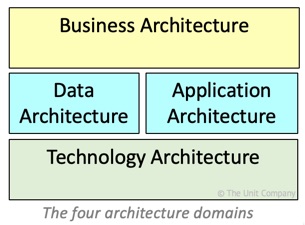
The TOGAF® framework and the four Enterprise architecture domains:
- Business architecture:
here the business strategy, governance and key business processes are defined. - Data architecture:
describes the technical data structures of the organization. - Application architecture:
the blueprint of the application landscape is drawn up here, in this blueprint the coherence and the interactions between the applications and the relationship with the business processes are described. - Technology architecture:
with this the software and hardware capabilities are meant to run all services. The technology architecture includes the IT infrastructure, middleware, networks, etc.
The TOGAF® Architecture Development Method
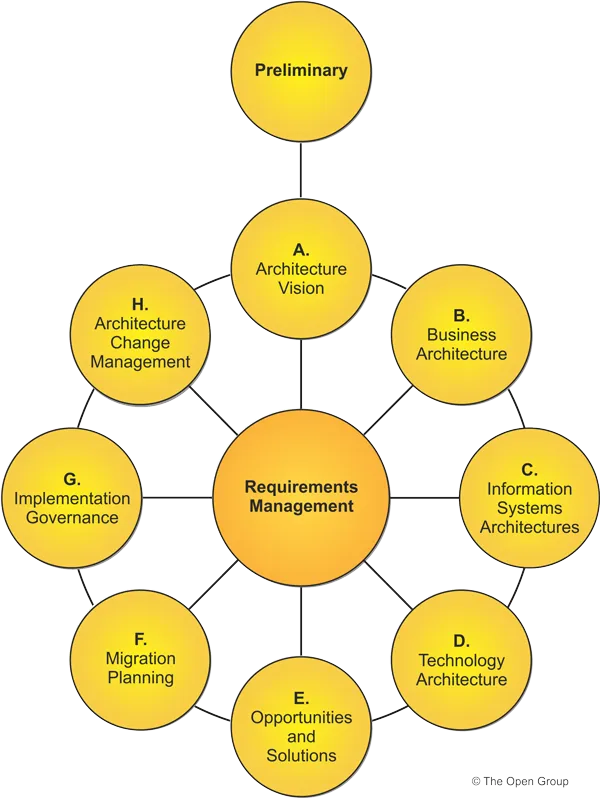
Within the TOGAF® framework the Architecture Development Method (ADM) is the core focus. The center of the cycles is Requirements Management, which is addressed in each of the other phases with the exception of the Preliminary phase.
The cycles start with a business case (phase A). Then the architecture building blocks are made (phase B, C and D). After drawing up the building blocks, we look for real solutions that can be implemented (phase E & F). When this plan is in place and the building blocks are made, the project or agile team can start with the implementation. This happens outside the ADM cycles, but in phase G and H the governance is done on the implementation process.
What is especially important to remember is that the ADM cycles is not a step-by-step approach, but an iterative flow in which Requirements Management is always central. It is a continuous process for organizing and managing these different requirements and the changes to them. These requirements are drawn up in terms of content within the other phases.
The 7 benefits of the TOGAF® standard
The implementation of the TOGAF® framework in your organization has many advantages, for both business and IT.

The TOGAF® Standard
- is the bridge between business strategy and IT implementation
- upports revenue generation and cost reduction by enabling faster, smarter projects
- provides transparency for business stakeholders
- ensures alignment of IT budget and business strategy and objectives
- stimulates smart re-use of existing processes, applications and infrastructure
- ensures sustainable business agility
- facilitates a pragmatic approach for IT projects
A TOGAF® use case – transformation from traditional retail to online webshop.
Topics in this use case:
- What is an Architecture Vision and how do I describe it?
- What are Solution Building Blocks (SBBs) and Architecture Building Blocks (ABBs) and how do I use them?
- How do I use the ADM in practice? And what are baseline and target architectures?

About TOGAF® Training and certification
- In this training you will learn about Enterprise Architecture and all ins and outs of the TOGAF® Framework.
- The training consists of a theoretical background and practical exercises.
- Within the training you will be guided by experienced trainers and you will work together with other students.
- After the training you will have sufficient knowledge to apply the TOGAF® standard in your daily work and to pass the exams.
- We will proctor your exams during the training. Alternatively you will receive exam vouchers.
About TOGAF® exams
To become a TOGAF® Certified professional, you need to pass two exams: the Level 1 (Foundation) exam and the Level 2 (Practitioner) exam. The exams are as follows:
Foundation (Level 1)
- 40 multiple choice questions
- You may not use the book during the exam
- You will have 60 minutes, 90 minutes if the English language is not your native language.
- You pass the exam when answered 60% correct
Practitioner (Level 2)
- 8 scenario based multiple choice questions
- Open-book exam via electronic copy in exam environment
- You will have 90 minutes, 120 minutes if the English language is not your native language
- You pass the exam when scored 60% correct
Attendees for this TOGAF® training include:
- Enterprise Architects
- IT Architects
- Solution Architects
- Business Architects
- Project Managers
- IT Specialists
- Software Engineers
- (IT) Managers
- Business Analysts